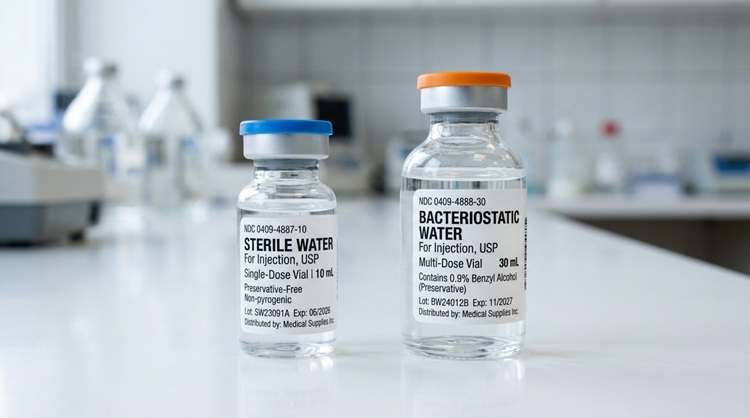
These two products seem quite alike visually when located on the shelf and verbally when talking about their use in common language. Both products are used for medication reconstitution. However, the use of either product instead of another will be regarded as a mistake. In some cases, the substitution of the two products may lead to very serious consequences.
First and foremost, the basic difference is the absence of additives. Sterile water for injection does not contain any additives; it is just the highly purified water.
Bacteriostatic water for injection consists of 0.9 % of benzyl alcohol. The presence of benzyl alcohol is a major change in the properties of the product and the way it is being used, the time period for its usage, the individuals who are allowed to use it and medications that can be mixed with this kind of water.
Single-use and multiple-use: practical aspects
As mentioned above, sterile water is used only once. It means that after opening and taking what is needed, the rest of the water should be thrown away because any additional opening will make it possible for the product to get infected with bacteria. As there is no bacteriostatic in the water (sterile water is just sterile water) once it has been opened, the bacteria will have quite comfortable place to stay.
As for bacteriostatic water, it can be used many times. As benzyl alcohol has bacteriostatic effect (it means that bacteria cannot multiply in it), it is possible to use this water for 28 days. During this time, it can be opened, used, closed again, opened again, etc. That is why bacteriostatic water has a special formula in it; the mixture of the water and the molecule slows down the growth of bacteria in it.
It is important to know that 28 day period is not made up. It means that the bottle should be marked with the date when the first use took place and discarded after 28 days even if there was some amount of the water left in the bottle. The use of a trusted product will allow you to be sure that the water has necessary bacteriostatic effect. The hospira bac water guarantees the concentration of benzyl alcohol and its bacteriostatic effect.
Individuals who should not use bacteriostatic water
Do not use bacteriostatic water for neonates. There is a danger of developing so-called gasping syndrome which is characterized by metabolic acidosis, central nervous system depression and cardiovascular collapse. The neonatal liver and kidneys do not have enough capacities to metabolize the benzyl alcohol and eliminate it. In case, the reconstituted medication needs to be given to a child, use the sterile water.
Never use bacteriostatic water in order to administer epidurally or intrathecally as there is no filtration system of the body and the benzyl alcohol can cause the damages of the nervous system.
In case the individual meets these criteria, consult your physician before using the water.
Chemical compatibility is not assured
Though the patient is an adult and has no contraindications, there is a possibility that benzyl alcohol is not compatible with all kinds of medications. Some types of drugs can decompose when they are mixed with benzyl alcohol, whereas the others can become precipitated. Compatibility has to be proven and tested.
However, this issue needs to be discussed with the pharmacist, not with Internet. The pharmacist knows what medications are used and has access to the compatibility data.
If you choose to use sterile water instead of bacteriostatic water, you will face another problem: the additional opening will give the opportunity for bacteria to infect the water as there will be no bacteriostatic in it.
Correct reading of the label
All the errors that take place when people take their medications at home happen due to the wrong recollection, not the right reading of the label. So, every time you are taking injections, try to spend some minutes on reading of the whole label.
You should pay attention to the following points:
The exact product name: sterile water for injection and bacteriostatic water for injection are two different products, though they seem alike
Preservatives: the presence of benzyl alcohol in bacteriostatic water
The name of the manufacturer: the product which has the label provided by the well-known manufacturer (Hospira, for example) will have the necessary information on the label
Expiration date: the expiration date provided by the manufacturer as well as the date of the first use marked by yourself (in case of multiple-dose vial)
If you find any words which are unknown to you, contact the pharmacist in order to be sure.
When to ask for help
Home-based caregivers preparing injections have to verify the process of clinical use in non-clinical setting. Provided that you will follow the same procedure as in the clinical settings, your patient will have no problems. The aseptic technique, correct diluent selection, compatibility tests and record keeping are obligatory.
The pharmacist is the best option in case of questions concerning the reconstitution of the medication – not because the information is confidential, but due to the knowledge and experience of pharmacists. Do not ignore unfamiliar labeling or unexpected substitution.
The two products which were described above are water-based, clear and used in reconstitution of the medication. They seem alike, however, they are different.